
Fabric Care
Many people do not realize that their furniture can have a longer life if they follow some very simple cleaning instructions.
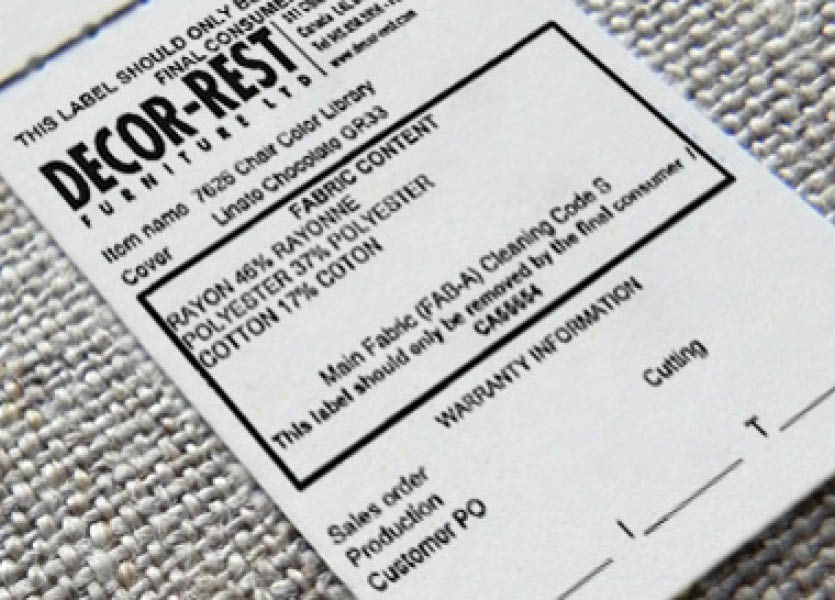
The Fabric Cleaning Code located under the seat cushions or bottom of furniture determines the best and least expensive method of home cleaning your furniture.
W - Water-Based Cleaner
To prevent dirt build-up, clean your furniture using a vacuum or light brush. To clean stains, use the foam only from a water-based cleaning agent such as a mild detergent or non-solvent upholstery shampoo. Be sure to apply the foam with a soft brush in a circular pattern and vacuum the area when dry. Try pre-testing a small area before proceeding. If you cannot remove the soiling or stain, be sure to use a professional furniture cleaning service.
S - Solvent Cleaner
To prevent dirt build-up, clean your furniture using a vacuum or light brush. To clean stains, always use a mild water-free solvent or dry cleaning product. Be sure to clean your furniture in a well-ventilated room and avoid any products containing toxic materials. Be sure to pre-test a small area before cleaning the entire surface. If problems result, contact a professional furniture cleaning service.
WS - Water/Solvent Cleaner
To prevent dirt build-up, clean your furniture using a vacuum or light brush. To clean stains, be sure to use a mild solvent, an upholstery shampoo, or the foam from a mild detergent. When using a solvent or dry cleaning product, always follow the instructions, clean only in a well-ventilated room, and avoid any product containing toxic materials. Again, be sure to pre-test a small area before cleaning the entire surface and contact a professional furniture cleaning service if the stain persists.
X - Vacuum Only
This fabric should be cleaned using a vacuum or light brush only. Water-based foam cleaners or solvent-based cleaning agents may cause excessive shrinking, staining, or other damage and should always be avoided. These guidelines have been developed by professional furniture specialists. However, there is no guarantee these tips will always be successful so use them at your discretion. When in doubt, consult with a professional cleaning service.
Cleaning Codes
W – Water-Based Cleaner
S – Solvent Cleaner
WS – Water/Solvent Cleaner
PILLING – WHY IT HAPPENS AND WHAT TO DO
Pilling is a phenomenon that has become more prevalent in recent years due to the more widespread adoption of flat woven fabrics. It was previously almost unknown within the Furniture Trade, whereas it had always been common in the Clothing Sector, particularly for example with Lamb's wool products.
It can occur on natural as well as synthetic fabrics and is more likely to be found on those woven from yarns that have been spun from a mixture of fibres. It is an inherent characteristic of certain fabrics during initial use and is not a fault with those fabrics.
Certain fibres are inherently "hairy". When they are spun into yarn, which is then used in flat woven fabrics, they create a fabric that displays a hairy surface.
It is this naturally hairy surface which creates the pilling. These loose surface fibres are not locked into the fabric or yarn structures and are therefore free to move. Therefore when the fabric is sat upon and used in the normal manner, the fibres are rubbed together which in time causes them to matt and create the little 'pilling balls'. The clothing equivalent would be the formation of pilling balls on a lamb's wool sweater once normal abrasive forces had taken their toll through nothing more than normal use.
Both situations can however be recovered by 'De-Pilling' the surface. This process is also called 'De-fuzzing' or 'Shaving' depending on whom you talk to. Naturally, the thought of shaving a very new item of furniture or clothing would cause most customers some concern, but in reality, the loose surface fibres are not a necessary or integral part of the fabric's main structure and are not essential to retain strength or wearability. They are surplus to requirements and as such can confidently be removed without compromising the performance of the fabric.
To damage a fabric that displays loose surface fibre, you would have to forcibly pull the fibre out of the surface with such force that more of the yarn would follow behind. This would then reduce the structural integrity of the fabric, creating the possibility of future premature failure. Shaving the loose fibres off with the appropriate machine, however, cuts only the surplus fibres and does so cleanly such that the fabric underneath remains structurally intact. It is therefore quite safe to remove the Pilling Balls once they have formed and the removal of the surplus fibre should then stop the recurrence of the problem. Generally speaking, fabrics that display a Pilling problem can be shaved once to resolve the situation. Occasionally it takes two goes, but this is usually because it was done too quickly in the first instance leaving some of the loose fibre behind which allows recurrence.
Unfortunately, Pilling occurs on new fabrics. It is however the very fact that they are new and therefore have an abundance of surplus fibre which causes this. Another parallel would be the loss of fibre from a new carpet. This is once again the loss of the surplus pile, which once removed allows the carpet to settle down and does not affect its future performance.
Pilling is therefore something that manifests itself on new items of furniture, but is one that can be resolved confidently without detriment to the future performance of the product. It is a characteristic found on certain types of fabric and one that cannot be treated before the fabric is cut. The Pilling Balls must first be allowed to form before they can be removed, so we cannot proactively solve the problem before the customer receives the finished item.
Upholstery pilling
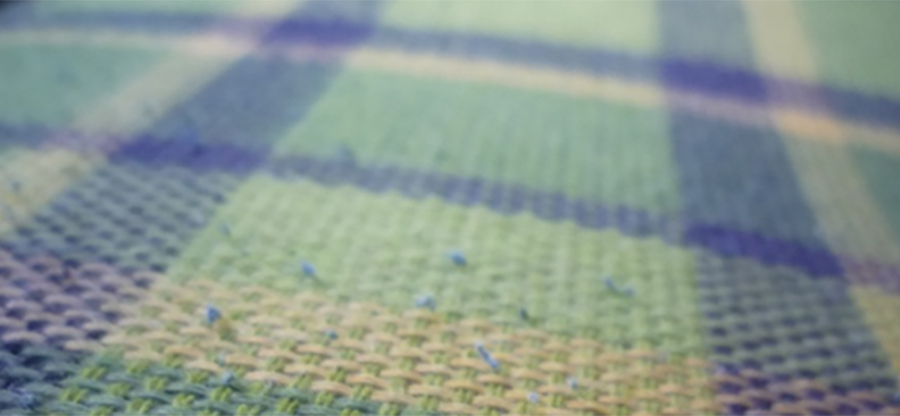
A pill is a small ball of fibres that form on the face of a piece of fabric. It is caused by abrasion on the surface of the fabric and is considered an unsightly occurrence on furniture.
What causes pilling?
Loose fibres have a natural tendency to move to the surface of a piece of fabric, where they are subject to friction, which causes them to twist together into small balls. Fibres that are still secured to the fabric are a so twisted into the ball so that the pill is secured to the surface of the material
Friction is caused in the normal course of people using the furniture, rubbing against the surface of the fabric. Laundering also causes friction - washing machines agitate fabric, causing the surfaces to rub together
Pilling is more noticeable on man-made fibres. This is mainly because natural fabrics shed loose fibres easily and less noticeably, while man-made fibres are notoriously strong so the pills are anchored strongly to the fabric
Should I send the fabric back?
It is important t to note that pilling is not a fabric defect or fault, and is not covered under warranty. It can be compared to the shedding experienced when purchasing a new carpet - think about the way the carpet behaves when newly installed, as there are constantly new loose fibers coming to the surface over the first few months of use. This is completely normal and will reduce once the excess fibers are gone.
Consumers are sometimes concerned that pilling means that tile fabric is wearing away and disintegrating - this is not the case. Pilling is a normal occurrence caused by wear and tear and does not affect the durability or functionality of the fabric. It is easily removable.
How do I remove pilling?
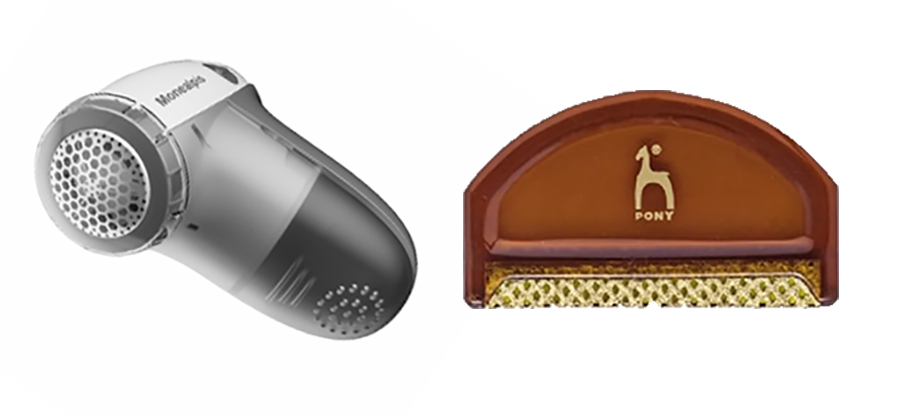
The quickest and most cost-effective approach is to use a battery-operated pill shaver to remedy the situation. These small, cheap appliances are available in most sewing stores, or the sewing area of large department stores. A pill comb is also effective and performs the same task manually
If pilling reoccurs, it can simply be shaved off again. This may occur several times, but, the pilling will diminish and eventually cease once the excess fibers are removed.
Can I buy fabric that doesn't pill?
Since all fabrics will pill to some extent the possibility of it happening should not be a main concern when choosing an upholstery fabric.
However, some fabrics are less likely to pill. Some are treated or coated during the manufacturing process to adhere excess fiber to the surface of the fabric. Some are also put through a singeing process, which quickly burns the excess surface fibers away.
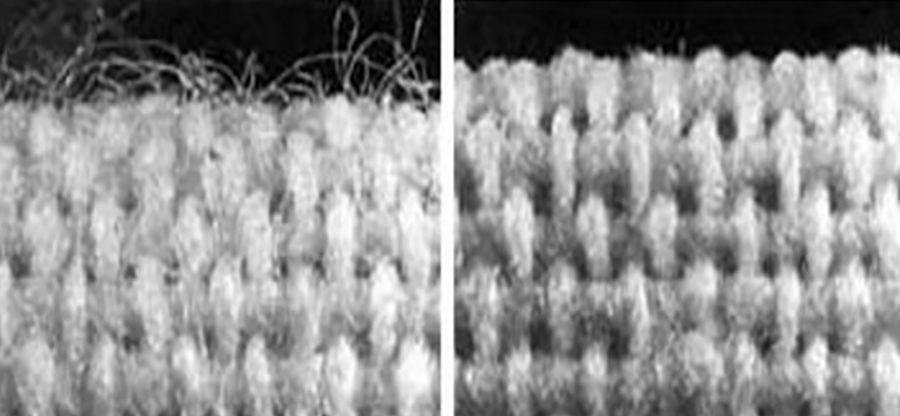
Above: Close-up of fabric before and after singeing (image by Osthoff-Senge)
Smooth, tightly woven fabrics and fabrics made from tightly twisted yarns are less likely to pill because the fibres are held tightly in the cloth.
When a fabric is made from more than one fibre type, where one fibre is strong and one is weak (for example, polycotton) pilling will be more noticeable, because the weaker fibre wears and breaks, while the stronger fibre holds the pills to the cloth.
Ultimately, if you notice that your furniture is developing pills, don t be alarmed. It is easily remedied and does not mean your furniture is made of poor-quality fabric.